Context
Line
The title of this work comes from the last paragraph of Henry Miller’s novel Black Spring: “But tonight I would like to think of one man, a lone individual, a man without name or country, a man whom I respect because he has absolutely nothing in common with you – MYSELF. Tonight I shall meditate upon that which I am.” This work is a deconstruction, reconstruction and disappearance of my work The Moon Landing Program. It shows that all will end in nihility. ( It is from the last sentence of Henry Miller’s Black Spring. I read it in 2017. After the Moon Landing Program, I didn't make any work for a year because I had begun to doubt absolutely myself. Questioning external world triggered off self-doubt.
During this period of uncertainty, I put everything into an artwork storage facility. At that time, I didn't have enough money to rent a good space so there were no windows and no light. When I walked into the storage room, I had to use a lighter to see, and it was at that moment that I realized, this situation of obscurity and darkness was a reflection of my feelings at that time. So, I made a replica of this dark storage situation in an exhibition space and covered the objects in charcoal to enhance their darkness.)
A new challenge on our visual perception, cognition, and consciousness.
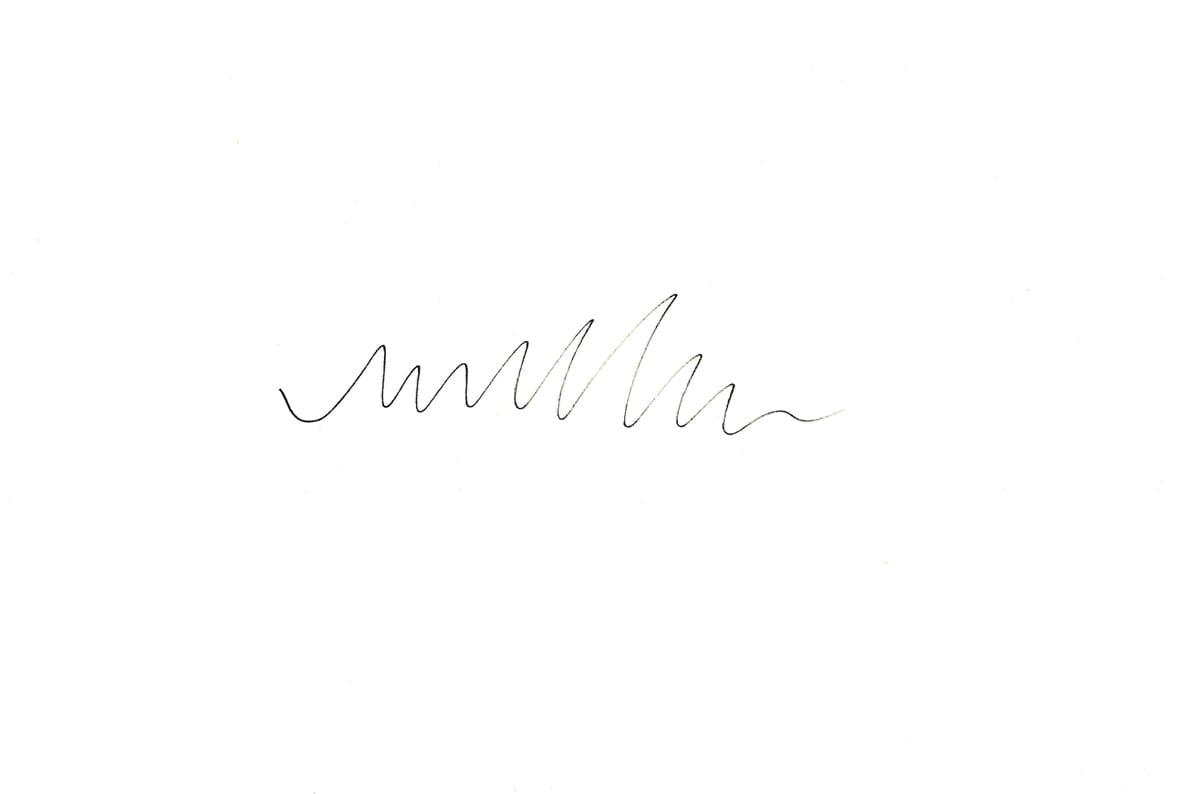
A random hand-drawn line is processed through the computer into visual coding. The coding is shown on a screen with a designated time order and creates a high Hertz flash of light. When a viewer looks attentively at presumed light presented on video, the brain responds to the flash signal and synchronizes the brainwave in parallel to the curve of the original drawing.
By receiving the flash signals, the brain (records and illustrates ) the ‘drawing’. It becomes a carrier and an exhibiting arena for this invisible line, largely activating and deflating the physical space between the work and the viewer
The work presents a different visual ‘interaction’ compared to that invoked by traditional artistic practices, questioning the ‘correct distance’ required to view an artwork. The action is invisible, yet irresistible.
The artwork impels both physical and psychological participation of various audiences. Now turn around, one will see the hand drawn line on the original drawing nailed on the opposite wall. Here are the three lines: The line on paper (visual) The line reflected in the viewers’ brain (physical) The deciphering of the line itself by the viewer (psychological) (I am interested in human and computer interaction and this work deals with the interface between brain and machine. I drew a random line and processed this through a computer into a visual code to produce flashes of light. When the viewer looks at these flashes of light, their brainwaves synchronise with the signals and experience spikes, which refer to curves in the original drawing. So in a way, the brain becomes a vehicle for this now invisible line.
When the work was exhibited, the viewer saw a video of the flashing light and on the opposite wall, the original line drawing. These two elements represent different stages of cognition; first, the line as reflected in the viewer’s brain as a physical reaction; and second, the drawn line on paper as a visual reaction, without knowing how the two are related.
The third element of cognition exists as an explanation of these visual and physical elements. The viewer deciphers the line, now understanding what they have seen as a psychological reaction.)