01 works
Plato’s Cube
2015
Series text
Plato’s Cube
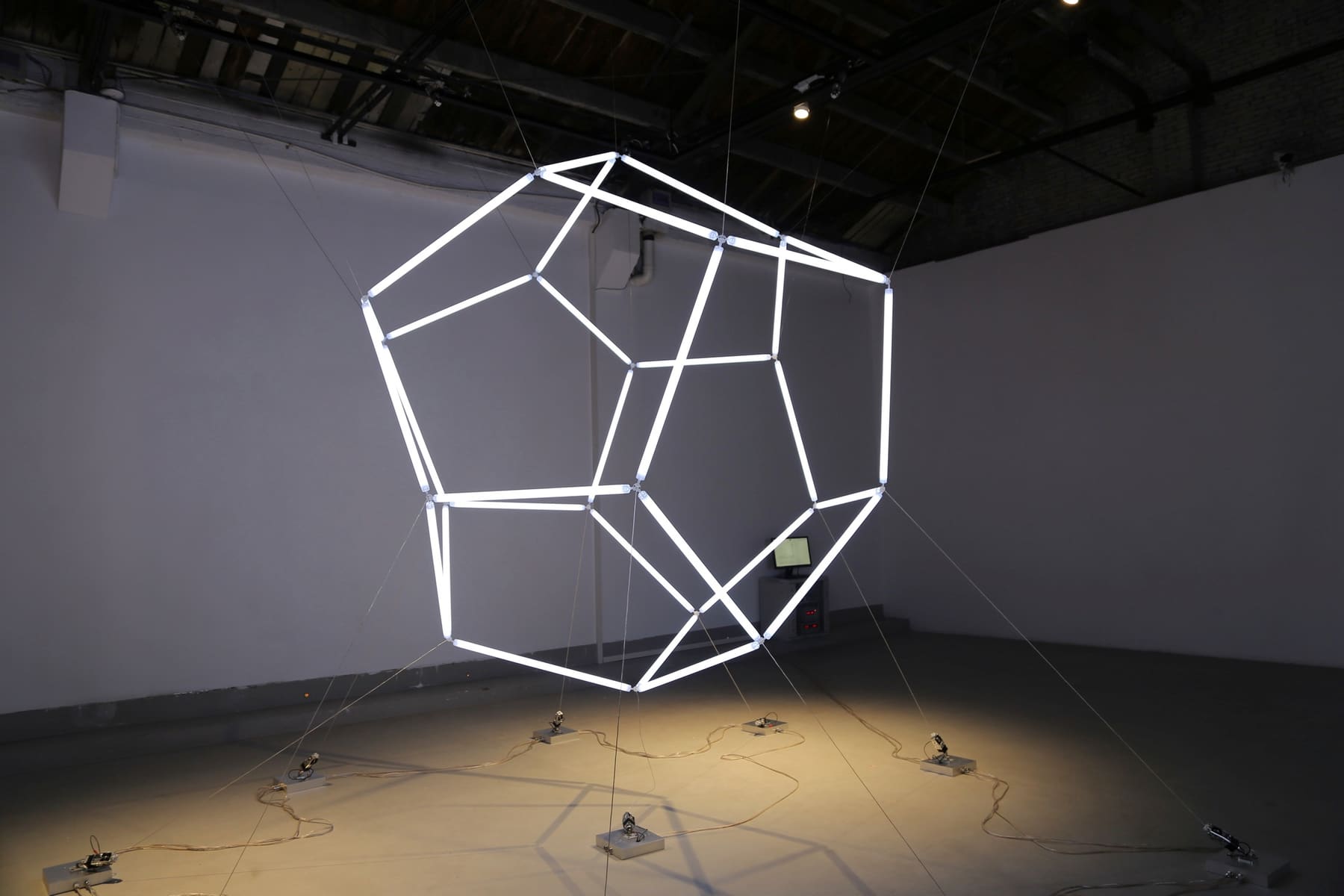
Plato’s Cube is formed by twelve white LED light tube. The Cube will no longer be in its original form from the starting point of the exhibition opening. Through the computer-controlled mechanism of tensile force, the cube will continuously change its form and the audience would not be able to any same or repeated structure of the Cube.
Structure: Transparent universal joints will be connecting each LED tube and allow electric cable to pass through itself. Forces from different angles will go through the universal joints that stretched the Cube, making it distorted and extruded. The powered winches on the wall rolls up and releases the steel wire, which the other ends are attached to the universal joints, creates forces to make the Cube changes its form. While the form of the Cube is changing, the position of the Cube could be moved around the space (top to bottom, left to right, front to back).
Mechanism: The core mechanism of this artwork is the process control. It includes two functions: (1) when one action starts, the computer will calculate and control all motors’ movements and the length of wires. Coordination of relations between many wires will be ensured; (2) the movement of all parts, the speed of the movement and whether there is a movement are completely randomized by the computer. All forms of action are not repeatable or manipulated by human. (Plato’s Cube is a dodecahedron formed by fluorescent light tubes. The 20 points of the shape correspond to 20 computers, which control their movements. Through randomised control of speed, motion and direction, the regular polygon transforms into an irregular one. The structure continuously changes, never returning to its original regular form. Each time the audience sees the structure it will be different. )